Kisocare
Retinol Cream (RE Cream) | KISOCARE
Couldn't load pickup availability
🚚 Free international shipping on orders over $50 USD / €50 EUR
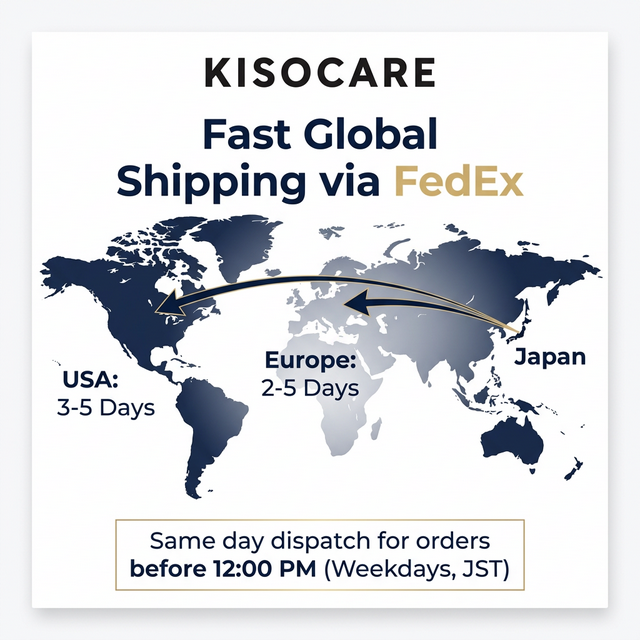
✈️ Ships from Japan | All Duties & Taxes Included. No Hidden Fees.We cover all import duties and taxes via FedEx DDP — no surprise charges at delivery. Estimated delivery: 1–3 days handling + 5–14 days transit to the US.
* Prices shown in USD for reference only. Payment is processed in Japanese Yen (JPY) at checkout.
Active Ingredient
Retinol, Bakuchiol, Niacinamide, EGF, CeramideRetinol 0.4%, Ceramide 5%
Apply a pea-sized amount to entire face after toner and essence. Use at night only.
Formulated in Japan. Patch test recommended for sensitive skin.
Why KISOCARE
| Feature | KISOCARE | Typical Clinical Serums |
|---|---|---|
| Fragrance | Free | Often added |
| Origin | Japan | Various |
| Ingredient grade | Pharmaceutical | Cosmetic |
| Unnecessary fillers | None | Common |
PRODUCT INTRODUCTION
A rich cream that locks in moisture. (Retinol Cream (RE Cream))
PRODUCT DETAILS
Protects the skin barrier and prevents moisture loss.
HOW IT WORKS
Forms a protective veil over the skin to keep it hydrated and smooth.
Directions for use
Use as the final step of your skincare routine. Apply pearl-sized amount to face.
INGREDIENTS
Water, Butylene Glycol, Octyldodecyl Myristate, Methylheptyl Laurate, Propanediol, Glycerin, Hydrogenated Lecithin, Hydrogenated Rapeseed Alcohol, Pentylene Glycol, Squalane, Dodecane, Retinol, Hydroxypinacolone Retinoate, Tocopheryl Retinoate, Retinyl Palmitate, Hydrogenated Retinol, Sodium Retinoyl Hyaluronate, Niacinamide, Bakuchiol, Argania Spinosa Kernel Oil, Simmondsia Chinensis (Jojoba) Seed Oil, Caprylic/Capric Triglyceride, Arachis Hypogaea (Peanut) Oil, Phytosterols, Ceramide NG, Ceramide AP, Ceramide AG, Ceramide NP, Ceramide EOP, rh-Oligopeptide-1, Sodium Acetylated Hyaluronate, Sodium Hyaluronate Crosspolymer-2, Hydrolyzed Sodium Hyaluronate, Sodium Hyaluronate, Dipotassium Glycyrrhizate, Citrus Aurantium Dulcis (Orange) Oil, Citrus Aurantium Dulcis (Orange) Peel Oil, Salvia Sclarea (Clary) Oil, Cananga Odorata Flower Oil, Lavandula Angustifolia (Lavender) Oil, Pelargonium Graveolens Oil, Cupressus Sempervirens Leaf/Nut/Stem Oil, Tocopherol, Centella Asiatica Extract, Scutellaria Baicalensis Root Extract, Polygonum Cuspidatum Root Extract, Glycyrrhiza Glabra (Licorice) Root Extract, Camellia Sinensis Leaf Extract, Rosmarinus Officinalis (Rosemary) Leaf Extract, Chamomilla Recutita (Matricaria) Flower Extract, Glyceryl Behenate, Polyglyceryl-6 Octastearate, Polysorbate 20, (PEG-240/Decyltetradeceth-20/HDI) Copolymer, Tocopheryl Acetate, Sodium Citrate, Dimethyl Isosorbide, Ethylhexylglycerin, Calcium Sodium Borosilicate, Silver Oxide
Precautions
- Do not use on skin with damage or abnormalities.
- Discontinue use if severe irritation occurs.
- Store away from direct sunlight and high temperatures.
- Keep out of reach of children.
KEY PRODUCT DETAILS:
- Skin Benefits: Clinical J-Beauty formulation targeted for highly effective skin conditioning, hydration, and visible improvement without synthetic additives.
- Scent: Synthetic Fragrance-Free (Unscented)
Share

Related Skincare Articles
-
What is Azelaic Acid? The Japanese Approach to ...
What is Azelaic Acid? The Japanese Approach to a Clearer, More Even Complexion For those seeking a visibly clearer and more refined complexion, Azelaic Acid has become one of the...
What is Azelaic Acid? The Japanese Approach to ...
What is Azelaic Acid? The Japanese Approach to a Clearer, More Even Complexion For those seeking a visibly clearer and more refined complexion, Azelaic Acid has become one of the...
-
Hydroquinone in Japanese Skincare: How J-Beauty...
Japan has a distinct relationship with skincare ingredients. The country's regulatory system, formulation philosophy, and consumer expectations create a context where certain ingredients — including hydroquinone — are approached differently...
Hydroquinone in Japanese Skincare: How J-Beauty...
Japan has a distinct relationship with skincare ingredients. The country's regulatory system, formulation philosophy, and consumer expectations create a context where certain ingredients — including hydroquinone — are approached differently...
-
Hydroquinone vs. Tranexamic Acid vs. Kojic Acid...
When exploring brightening ingredients in skincare, three names appear frequently across scientific literature, dermatology discussions, and product formulations: hydroquinone, tranexamic acid, and kojic acid. Each has a distinct background, mechanism,...
Hydroquinone vs. Tranexamic Acid vs. Kojic Acid...
When exploring brightening ingredients in skincare, three names appear frequently across scientific literature, dermatology discussions, and product formulations: hydroquinone, tranexamic acid, and kojic acid. Each has a distinct background, mechanism,...